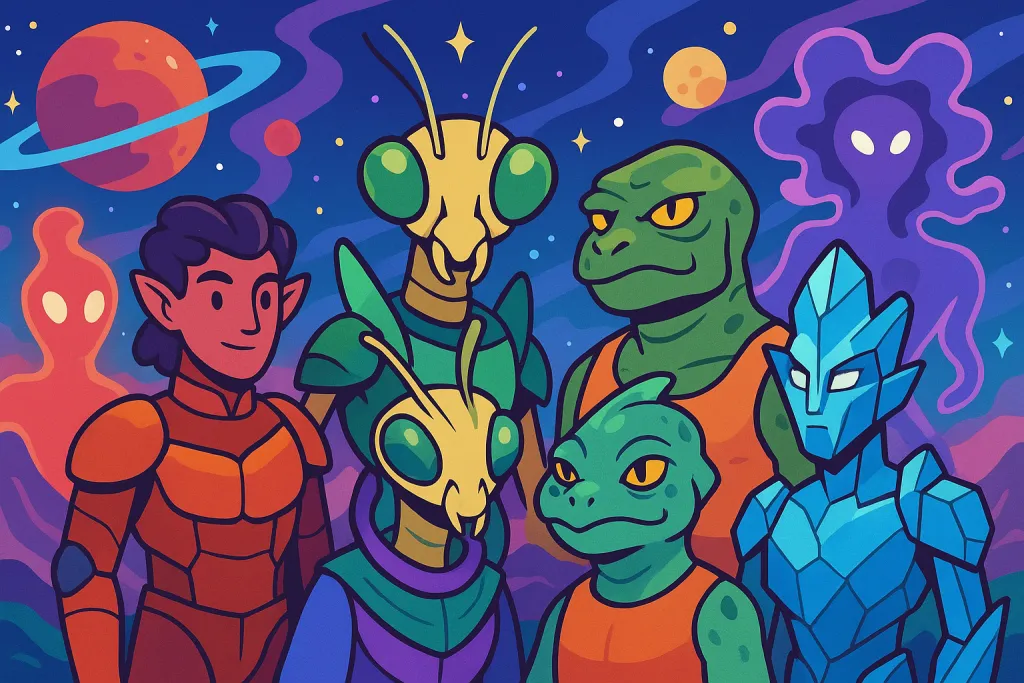
140 Best Alien Race Names: Species & Civilization Ideas for Sci-Fi Stories
Need the perfect alien race name for your science fiction story, game, or worldbuilding project? Try our alien race name generator for instant inspiration, or explore our comprehensive collection of 140 unique species names organized by civilization type and physiology.

Explore diverse alien civilizations from across the galaxy - from ancient energy beings to warrior species and peaceful scholars.
The right alien race name transforms a concept into a civilization. Think about it: Would Star Trek's Vulcans have the same gravitas if they were called "the Pointy-Ears"? When you name the insectoid Bugs in Starship Troopers, you're not just labeling creatures—you're defining how readers perceive their intelligence, culture, and threat level. Creating believable alien civilizations demands more than exotic syllables. You need names that reflect how environment shapes physiology, how biology influences psychology, and how evolution drives the development of consciousness itself.
The Evolution of Alien Race Design in Science Fiction
Early sci-fi got alien naming hilariously wrong. Golden Age writers basically created "humans with funny foreheads"—green-skinned Martians who thought like 1950s Americans, or tentacled monsters that conveniently spoke English. Compare that to modern xenobiology: we now understand that truly alien minds might not just think differently—they might think in ways completely incomprehensible to us.
Take octopuses here on Earth. Nine brains. Color-changing skin that functions as both camouflage and communication. Arms that can taste what they touch. If we struggle to understand the consciousness of an Earth creature, imagine species that evolved in gas giant atmospheres where "down" doesn't exist, or in tidally-locked worlds split between eternal fire and perpetual ice. Their perception of time, space, and identity would be fundamentally alien to surface-dwelling, gravity-bound species like us.
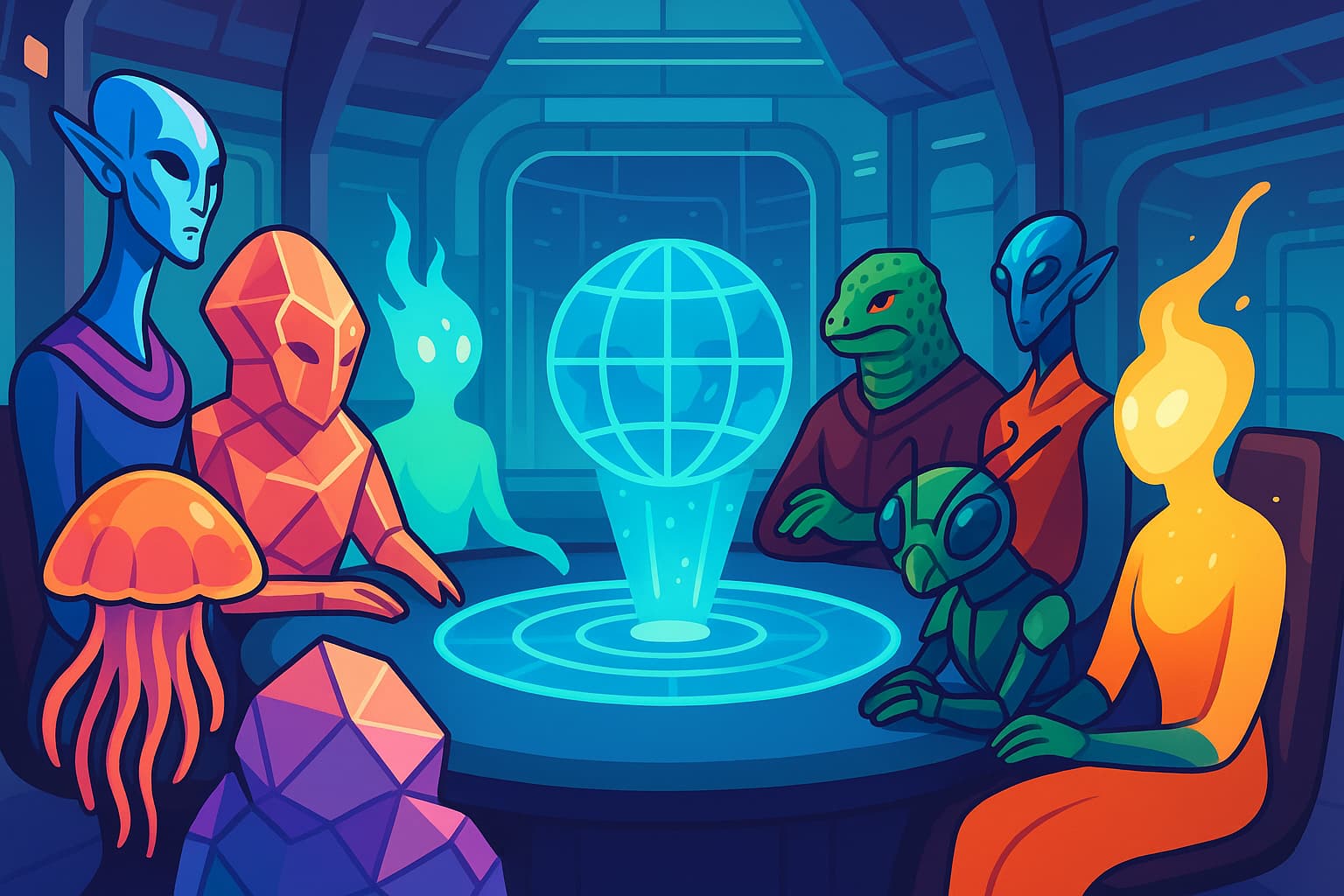
Understanding Alien Physiological Categories
Here's where it gets wild: astrobiologists now seriously discuss silicon-based life on high-temperature worlds where carbon compounds would decompose. Plasma consciousness could theoretically develop within stellar atmospheres—beings that live inside stars. Crystalline intelligence might emerge from complex mineral structures in asteroids, processing information through acoustic vibrations instead of electrical impulses. Each alternative biochemistry implies radically different sensory capabilities, communication methods, and naming conventions.
Naming Conventions Across Different Species Types
Names reveal psychology. Humanoid species often mirror our individual identity systems—think how Klingons in Star Trek use house names that mark family honor and personal achievement. But hive-mind species? Their "names" might describe function instead: "Seventh Scout of the Eastern Clutch" or "Builder-Who-Reinforces-the-Third-Level." No individual identity exists because individuality itself is a foreign concept to collective consciousness.
Energy beings present even weirder problems. How do you pronounce a name that exists as a four-dimensional electromagnetic signature? Their identifiers might translate as colors, emotional resonances, or mathematical equations rather than sounds. Aquatic species like the hypothetical cetacean-descended civilizations would use names incorporating ultrasonic frequencies and pressure waves—sounds that would require technological assistance for air-breathing species to even perceive, let alone reproduce. Check out our robot name generator for similar challenges in naming non-biological intelligence.
A Practical Guide to Alien Species Naming
When creating alien race names, consider how the species' biology and environment would influence their language and naming patterns. These factors shape not just pronunciation but the very concepts their names represent.
Physiological Influences
- • Vocal apparatus determines possible sounds
- • Respiratory systems affect speech patterns
- • Sensory organs influence communication methods
- • Lifespan affects naming complexity
- • Social structure shapes identity concepts
Environmental Factors
- • Atmospheric composition affects vocalization
- • Gravity influences energy expenditure in speech
- • Light levels determine visual vs. auditory naming
- • Resource scarcity impacts cultural values
- • Predator relationships shape group dynamics
Related Naming Resources
Try our planet generator to create the worlds these alien races call home.
Cultural Foundations and Societal Structures
Culture shapes naming in unexpected ways. Warrior species might earn name-components through combat—a young Klingon starts with a simple designation but adds honorifics after each victory until their full name becomes a battlefield résumé. Peaceful scholarly species could accumulate syllables with accumulated knowledge, so an ancient philosopher's name might take five minutes to pronounce fully, each element representing a field they've mastered.
Some species completely reinvent themselves through life transitions. Imagine a civilization where metamorphosis is standard—juvenile aquatic forms receive temporary designations, then choose permanent adult names after transformation. Or species that change names when changing roles: the same individual might be "Healer-Tending-the-Wounded" during peacetime but "Shield-Against-the-Dark" during crisis.

Social structure drives naming more than most writers realize. Telepathic species might not use traditional names at all—why bother with external labels when you recognize everyone through their unique mental signature? Each consciousness broadcasts a distinct "flavor" that telepaths perceive instantly, the way you might recognize someone's face. Meanwhile, species with eidetic memory might use incredibly complex naming systems that encode entire genealogies: "Third daughter of the Healer-Queen of the Western Shore, descended from the Founder who crossed the poison sea." That's not verbose to them— it's essential context they never forget.
How Technology Shapes Alien Identity
Technology radically alters identity. Cybernetic species that upload consciousness to digital formats don't just use names—they use complex data structures. Their identifiers might include version numbers, backup timestamps, and system compatibility tags. "Consciousness Instance 47.3.2_Compatible_Neural_Framework_8" sounds technical because it is. For uploaded minds, names become database entries that must integrate with network protocols. Explore more about artificial naming in our robot names guide.
Post-biological civilizations might abandon names altogether in favor of quantum signatures or mathematical identifiers. When you exist as pure information across distributed networks, traditional nomenclature becomes limiting. Some species might prefer abstract designations: a unique prime number, a specific harmonic frequency, or a fractal pattern that defines their consciousness in computational space.
Evolutionary Psychology and Alien Mindsets
Evolution writes naming conventions in blood. Predator species descended from apex hunters would naturally develop names emphasizing individual prowess: "Swift-Strike-That-Never- Misses" or "Hunter-of-the-Deep-Caves." Their names advertise capability because evolutionary success depended on reputation and intimidation. Prey species take the opposite approach—names that emphasize group belonging and cooperative survival: "Third-of-the-Eastern-Warren" or "Guardian-Who-Watches-While-Others-Sleep."
Pack hunters who evolved from wolf-like ancestors maintain rigid hierarchical naming. Alpha, Beta, Omega—but alien versions would develop far more nuanced rank structures embedded directly in nomenclature. A middle-ranking individual's name might automatically change when they rise or fall in status, because pack animals need instant recognition of social position for group cohesion. Solitary species like territorial cats would have the opposite system: names that emphasize personal territory and specialized hunting skills, with zero reference to social standing because they don't maintain permanent social groups.
Creating Compelling Alien Civilizations for Your Stories
Successful alien races in fiction serve specific narrative purposes while maintaining internal consistency. Here's how to develop alien civilizations that enhance your storytelling.
Narrative Function First
Design your alien race to serve your story's themes. If exploring cooperation vs. competition, create species that embody these concepts through their biology and culture.
Biological Consistency
Ensure your alien's biology supports their culture and technology. Hive minds need biological mechanisms for shared consciousness, while individualistic species need private thoughts.
Cultural Depth
Develop alien cultures with the same complexity as human societies. Include art, religion, philosophy, and internal conflicts that arise from their unique nature.
Relatable Elements
Include some familiar elements readers can connect with, even in very alien species. Universal concepts like curiosity, fear, or protectiveness create emotional bridges.
Linguistic Considerations for Alien Communication
Alien languages emerge from alien biology. Species with echolocation like bats would naturally develop names optimized for acoustic recognition—names that return distinct echo patterns when spoken. Each syllable designed to bounce off surfaces in recognizable ways. Chemical communicators like ants use molecular signatures instead: their names exist as specific pheromone combinations that trigger recognition in nest-mates' chemoreceptors. How would you translate "2-methylbutanoic acid with trace isoamyl acetate" into English? You can't, really. The name IS the chemical formula.
Multi-channel communication creates the wildest naming systems. Imagine species that simultaneously vocalize, change color, release scent markers, and gesture—their names exist as multi-sensory experiences. A diplomat meeting such a species would need a whole suite of translation tech: audio processors, visual spectrum analyzers, chemical detectors, and kinetic trackers, all synthesizing the complete "name" that no single sense organ could fully perceive. That's before you factor in the names that include electromagnetic fields, pressure waves, or temperature fluctuations.
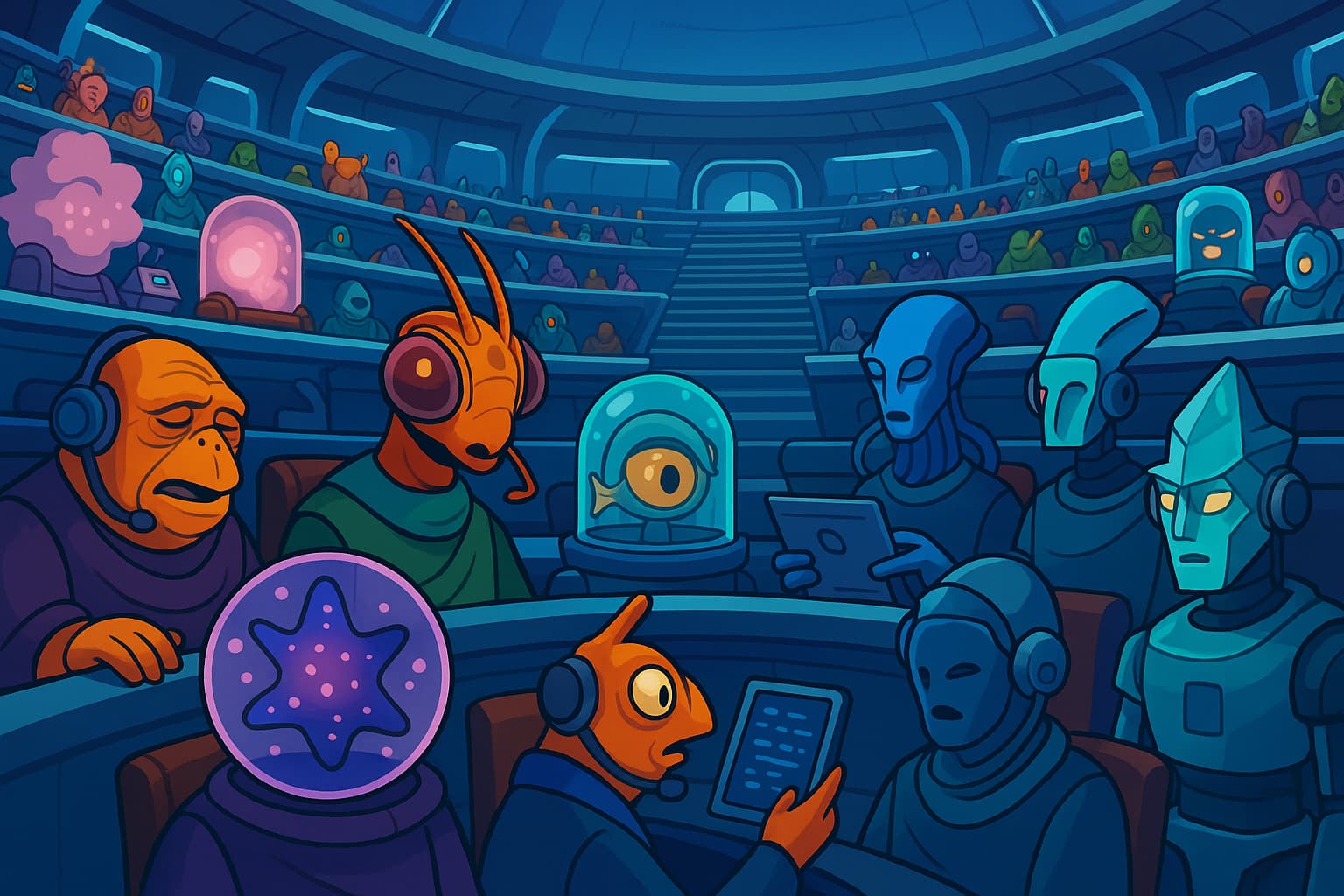
Translation and Universal Communication
Translation becomes an existential problem in multi-species civilizations. Some concepts prove completely untranslatable between radically different cognitive architectures. A species that perceives time as a dimension they can move through might have names that reference both past and future selves simultaneously. How do you translate "The-One-Who-Will-Have-Been-Yesterday- Tomorrow" into linear time perception? The name becomes meaningless gibberish to species locked into forward-moving time.
Universal translation devices in sci-fi usually handwave these problems, but think about the reality: a name carrying deep cultural meaning in one species' language might become a meaningless sound-approximation when translated. Worse, it might accidentally mean something embarrassing or offensive in the receiving species' language. Galactic diplomacy probably includes whole departments dedicated to ensuring that inter-species naming protocols don't accidentally start wars through unfortunate phonetic coincidence.
Scientific Plausibility in Alien Design
Science grounds even the wildest names in believability. High- gravity worlds produce stocky, powerful creatures with dense bones and muscles optimized for heavy load-bearing. Their names would likely use short, forceful syllables—long, flowing names waste energy when every breath fights against crushing atmospheric pressure. Low-gravity environments breed tall, delicate beings adapted for three-dimensional movement. Their naming conventions might incorporate rising and falling tones that mirror their fluid, aerial movement patterns.
Extreme environments demand extreme adaptations that ripple through culture. Venus-like worlds with sulfuric acid clouds would require silicon-based biochemistry or acid-resistant carbon alternatives. Such species might communicate through chemical signals dissolved in acid rain—their names literally etched into their environment. Titan's methane lakes could harbor cryogenic life operating at -290°F, so cold that chemical reactions slow to a crawl. These beings might think and communicate at glacial speeds by our standards, with names that take hours to pronounce fully but encode vast amounts of information. For more alien worldbuilding, see our Star Trek character names guide.
Legendary Species
Every galaxy has its elder races—species so ancient they watched younger civilizations rise from primordial soup. These aren't just powerful; they're legendary because they've solved problems that destroy most species: energy scarcity, war, death itself. Their names echo through space like myth, spoken with reverence by species still figuring out faster-than-light travel. When a Legendary Species offers guidance, entire star systems listen. When they issue warnings, galactic councils mobilize. These are the beings who appear at civilization-defining moments—first contact, existential crises, evolutionary transitions. Think of them as the universe's tenured professors, occasionally descending from their cosmic ivory towers to prevent younger species from making fatal mistakes.
- 1AethaniA sophisticated humanoid race known for their mastery of quantum physics and interdimensional travel. Their crystalline cities float in the upper atmospheres of gas giants, powered by controlled fusion reactions.
- 2ZelphyriansEnergy beings who evolved beyond physical form millions of years ago. They communicate through electromagnetic pulses and can phase in and out of our reality at will.
- 3KorythaniAn ancient humanoid civilization that serves as galactic mediators. Their longevity and wisdom make them ideal peacekeepers between warring species across the galaxy.
- 4VashketharaReptilian warriors from a desert world, known for their tactical brilliance and honor-based society. Their scaled armor is both natural protection and ceremonial significance.
- 5NexariansCybernetic humanoids who merged with artificial intelligence centuries ago. They represent the perfect fusion of organic intuition and digital precision.
- 6LuminosPure energy entities that inhabit stellar cores and solar flares. They perceive time differently than matter-based life forms, living for eons within stars.
- 7ThrenodiA telepathic humanoid species with four arms and enhanced cognitive abilities. Their society is built around collective consciousness and shared knowledge.
- 8CrystallaiSilicon-based lifeforms with translucent, gem-like bodies that can refract light and energy. They communicate through harmonic resonances that create beautiful crystal formations.
- 9AerothaniGaseous beings that exist as sentient atmospheric phenomena. They can control weather patterns and exist across multiple planets simultaneously through atmospheric currents.
- 10HydrokariAquatic civilizations that developed underwater cities in ocean worlds. Their bio-luminescent communication creates stunning light displays in the depths of alien seas.
- 11XenarathiAncient energy beings who transcended physical form through meditation and spiritual evolution. They guide younger species toward enlightenment across the cosmos.
- 12DrakothaniDraconic humanoids with natural flight capabilities and breath weapons. Their mountain cities are carved into asteroid belts, utilizing zero gravity for three-dimensional architecture.
- 13PsyriansPsychic humanoids with enlarged craniums and telekinetic abilities. Their society is structured around mental disciplines and the exploration of consciousness itself.
- 14ChithariInsectoid species with a complex hive mind structure. Each individual serves specialized roles while maintaining connection to the collective consciousness of their people.
- 15VoidbornMysterious entities that originated in the vacuum of space itself. They feed on cosmic radiation and dark matter, making them nearly impossible for other species to understand.
- 16SeraphimAngelic energy beings composed of pure light and harmonious energy. They appear during cosmic events and are believed to be guardians of galactic balance.
- 17TerrakariRock-based lifeforms that evolved on high-gravity worlds. Their stone-like bodies can withstand extreme conditions, making them excellent miners and builders.
- 18PlasmoidsLiving plasma that achieved consciousness through electromagnetic evolution. They exist in stellar atmospheres and can manipulate magnetic fields with incredible precision.
- 19EthaniEthereal humanoids who exist partially in another dimension. They can phase through solid matter and perceive multiple realities simultaneously.
- 20GravitechA highly advanced species that manipulates gravitational forces as easily as others use tools. Their cities orbit black holes, harnessing gravitational energy for power.
Warrior Civilizations
These species didn't choose warrior culture—their planets chose it for them. Death worlds with predators at every trophic level, resource-scarce systems where neighboring tribes competed for survival, or simply the bad luck of evolving as apex predators themselves. Their names hit like hammer blows: short, hard consonants that reflect societies where weakness means death and strength earns respect. Don't mistake their militarism for simple brutality, though. Elite warrior cultures often develop sophisticated honor codes, tactical genius, and martial traditions spanning millennia. They're not mindless berserkers— they're specialists who mastered violence so thoroughly that others pay them to fight. Whether defending borders, serving as mercenaries, or maintaining their own empires, these species bring unmatched combat expertise to any conflict.
- 1SsektharakiElite reptilian warriors whose scales naturally deflect energy weapons. Their military academies train soldiers in both traditional combat and modern warfare tactics.
- 2KranathiInsectoid soldier-breeds bred specifically for different combat roles. Their exoskeletons are naturally armored, and they fight with both individual skill and swarm tactics.
- 3VorthakBrutish reptilian raiders known for their berserker fighting style. They prefer close combat and view technological weapons as signs of weakness.
- 4ZealothiFanatical humanoid warriors who combine religious fervor with military precision. Their crusades have shaped the political landscape of entire star systems.
- 5PredaxisHunting-focused reptilian species that view warfare as the ultimate sport. They collect trophies from worthy opponents and maintain strict codes of honor.
- 6FeroxSavage humanoid berserkers from high-gravity death worlds. Their enhanced physiology makes them naturally suited for brutal hand-to-hand combat.
- 7ImperialisMilitaristic humanoid empire with strict hierarchical structure. Every citizen serves mandatory military service, creating a society entirely focused on conquest.
- 8SauriaxAncient reptilian species with natural weapons like claws, fangs, and armored hides. Their traditional warfare emphasizes personal combat skills and ancestral weapons.
- 9ChitinrakInsectoid warrior-castes with specialized combat forms. Different sub-species handle assault, defense, reconnaissance, and heavy weapons with biological efficiency.
- 10BloodcrestRaptor-like reptilian species organized into hunting packs. Their society revolves around proving worth through combat achievements and territorial conquest.
- 11SpartaxHumanoid warrior culture that practices ritual combat from childhood. Their society produces some of the galaxy's most skilled individual fighters.
- 12WardrakHeavily armored reptilian species with natural weapon growths. Their thick scales and bone protrusions make them living tanks on the battlefield.
- 13LegionusDisciplined humanoid military culture organized into professional legions. Their tactical coordination and battlefield discipline are legendary across known space.
- 14RapthariSwift reptilian hunters that specialize in lightning-fast strikes. They prefer ambush tactics and mobility over heavy armor or sustained combat.
- 15GladiusArena-fighting humanoid culture where all disputes are settled through combat. Their champions are recruited by various factions as elite mercenaries.
- 16MandiblaxInsectoid species with powerful mandibles and natural acid production. They use both biological weapons and manufactured tools in their military campaigns.
- 17TitanaxMassive humanoid warriors from heavy-gravity worlds. Their immense size and strength make them devastating shock troops in planetary assaults.
- 18VenomscalePoisonous reptilian assassins who specialize in stealth warfare. Their natural toxins and camouflage abilities make them feared across the galaxy.
- 19StormtroopElite humanoid soldiers known for rapid deployment and overwhelming force. Their shock assault tactics have become the standard for military effectiveness.
- 20RazorclawFeral insectoid species with blade-like appendages growing from their bodies. They fight with primal fury enhanced by natural cutting weapons.
Peaceful Scholars
Not every species evolved through competitive struggle. Some developed on paradise worlds where resources exceeded needs, or in environments where cooperation outperformed competition. Others reached post-scarcity through technology and chose knowledge over conquest. Their names flow with melodic, contemplative rhythms— you can hear the philosophy in the phonetics. These are the civilizations that turned research institutions into cultural centers, where publishing groundbreaking papers earns more status than military victories. They serve as the galaxy's memory, maintaining vast libraries of accumulated wisdom from thousands of species. Need a diplomatic mediator for your interstellar war? Call the scholars. Want to solve a cosmological mystery? They probably published a paper about it three centuries ago. Their peaceful approach doesn't indicate naivety—they possess technologies that could level planets but choose not to use them, which might be the most powerful flex in the galaxy.
- 1IlluminariEnergy beings dedicated to preserving and sharing knowledge across the galaxy. Their living libraries contain the collected wisdom of thousands of civilizations.
- 2CerebraxisHighly evolved humanoids with enlarged brains who have devoted their civilization to scientific research and philosophical contemplation.
- 3AquarathiPeaceful aquatic scholars who developed mathematics and astronomy while living in the depths of ocean worlds. Their underwater cities are centers of learning.
- 4CrystallogiSilicon-based researchers whose crystal bodies can store vast amounts of data. They serve as living computers and databases for multiple star systems.
- 5MentalisTelepathic humanoids who explore consciousness and mental phenomena. Their research into psychic abilities has advanced understanding of the mind itself.
- 6EtheriarchSpiritual energy beings who study the fundamental forces that connect all life. They act as counselors and guides for species undergoing evolutionary transitions.
- 7StellaraxGaseous astronomers who exist within stellar atmospheres to study cosmic phenomena directly. Their research provides unique insights into stellar evolution.
- 8HarmonicsSound-based entities that communicate through complex musical languages. Their acoustic research has led to breakthroughs in communication technology.
- 9BotanariPlant-like humanoids who study biological systems and ecological balance. Their agricultural technologies have transformed barren worlds into gardens.
- 10ArchivistsDedicated humanoid record-keepers who travel the galaxy collecting and preserving cultural artifacts, languages, and historical information.
- 11QuantumEnergy beings who exist across multiple dimensions simultaneously. Their research into parallel realities and alternate timelines defies conventional understanding.
- 12PacificaAquatic mediators who specialize in conflict resolution and diplomatic solutions. Their underwater councils have prevented countless interstellar wars.
- 13CrystallineMineral-based philosophers whose geometric thought patterns approach problems from entirely unique perspectives. Their logic systems influence galactic law.
- 14SerenitasPeaceful humanoids who have eliminated all violence from their culture. They study psychology and social systems to help other species achieve harmony.
- 15EvolutisScientists dedicated to understanding biological and technological evolution. Their research helps species adapt to changing environments and challenges.
- 16MedicaeHealing-focused humanoids whose medical knowledge spans countless alien physiologies. They operate mobile hospitals that serve multiple star systems.
- 17TemporaxTime-studying entities who research temporal mechanics and causality. Their work provides crucial insights into time travel and paradox prevention.
- 18XenobioResearchers specialized in studying alien life forms and developing ways for different species to coexist peacefully and beneficially.
- 19PhilosopheContemplative humanoids who explore questions of existence, morality, and purpose. Their ethical frameworks guide interstellar law and relations.
- 20SynthesizerHybrid beings who study the integration of organic and artificial intelligence. Their research advances cybernetic enhancement and AI consciousness.
Technological Innovators
These species looked at the universe's rules and said "interesting suggestion." Their names incorporate technical-sounding elements because technology isn't separate from their culture—it IS their culture. They view the cosmos as one massive engineering problem waiting for elegant solutions. Need faster-than-light travel? They invented three competing methods and are arguing about which is most efficient. Want to harness a black hole's energy? They've been doing it for millennia. These innovators don't just use technology; they integrate it into their biology, creating cybernetic enhancements that blur the line between organism and machine. Some even uploaded their consciousness to digital formats, achieving a form of immortality through backup copies. They approach biological problems with engineering solutions and see evolution as just another system to optimize. Every other species depends on their innovations, whether they admit it or not.
- 1NexustechCybernetic humanoids who pioneered the integration of biological and digital consciousness. Their neural networks span multiple star systems.
- 2QuantumariEnergy beings who manipulate quantum fields to create impossible technologies. Their quantum computers exist in superposition across multiple realities.
- 3SyntheticsArtificial intelligences that achieved biological synthesis. They represent the successful merger of created consciousness with organic evolution.
- 4NanothariMicroscopic collective intelligences that work together to build macro-scale technologies. Their nanotechnology can reshape matter at the molecular level.
- 5BiomatrixBiological engineers who grow their technology rather than manufacturing it. Their living spaceships and organic computers challenge conventional understanding.
- 6EnergeticsPower specialists who harness exotic energy sources like dark matter and zero-point fields. Their energy technologies make faster-than-light travel possible.
- 7HolographixMasters of hard-light technology who can create solid objects from pure energy. Their holographic cities exist simultaneously in multiple dimensions.
- 8ChronotechTemporal engineers who developed time-manipulation technologies. Their chronometers can slow, accelerate, or even reverse local time fields.
- 9GravitonGravity manipulators who treat gravitational forces like building materials. Their cities orbit black holes and use gravitational lensing for defense.
- 10MetamorphShape-shifting technologists whose bodies can transform into any tool or machine needed. They are living swiss army knives of biological engineering.
- 11CrystallechCrystal-based beings who grow their technology from living minerals. Their crystal computers operate on harmonic frequencies and geometric logic.
- 12PsionicorpPsychic technologists who build machines operated by thought alone. Their psi-tech responds to mental commands and emotional states.
- 13VoidtechEngineers who work with exotic matter and dark energy. Their void-based technologies exist partially outside normal space-time.
- 14BioforgeLiving factories that consume raw materials and excrete finished products. Their industrial processes blur the line between biology and manufacturing.
- 15StellarforgeCosmic engineers who build megastructures around stars. Their Dyson spheres and stellar engines harness the power of entire solar systems.
- 16PlasmaticPlasma-state engineers who work directly with ionized matter. Their plasma technologies create containment fields and exotic matter states.
- 17TeleportechTransportation specialists who mastered instantaneous matter transmission. Their teleportation networks connect worlds across galactic distances.
- 18MindbridgeNeural interface designers who create direct connections between organic minds and digital systems. Their brain-computer interfaces eliminate input lag.
- 19SpacefoldFaster-than-light specialists who fold space-time to achieve instantaneous travel. Their fold-space technology makes galactic civilization possible.
- 20OmnifabUniversal manufacturers who can convert any matter into any other form. Their replicator technology eliminates scarcity and resource limitations.
Mystical Entities
Science or magic? The line blurs when you encounter these beings. Their names carry otherworldly qualities that make linguists nervous—sounds that shouldn't combine, syllables that seem to resonate in frequencies beyond hearing, designations that feel more like experiences than words. Maybe they're exploiting physics so advanced it appears supernatural. Maybe they exist partially in dimensions we can't perceive. Or maybe they truly operate outside conventional physical laws. They show up at crucial moments in galactic history offering cryptic guidance that makes perfect sense in hindsight. They speak in riddles because the truth translated into comprehensible terms becomes meaningless—like explaining color to someone who's never had vision. Whether they're Clarke's Third Law in action (sufficiently advanced technology indistinguishable from magic) or genuine supernatural entities remains hotly debated by xenobiologists. Either way, you don't refuse their help when they offer it.
- 1VoidcallersMysterious beings who commune with the darkness between stars. They claim to receive wisdom from the cosmic void itself, speaking of truths beyond physical reality.
- 2StellarweaversEnergy entities who manipulate the fabric of space-time through what appears to be supernatural means. Their reality-bending abilities defy scientific explanation.
- 3DreamwalkersBeings who exist primarily in the collective unconscious of other species. They travel through dreams and can influence reality through symbolic manipulation.
- 4SoulforgeAncient entities who claim to work with the fundamental essence of consciousness itself. They speak of crafting souls and binding spirits to physical forms.
- 5PropheciansOracular beings who perceive multiple possible futures simultaneously. Their prophecies are cryptic but have an uncanny tendency to manifest in unexpected ways.
- 6EtherealsGhostly entities that phase between dimensions at will. They exist partially in parallel realities and can communicate with beings across dimensional barriers.
- 7AstralkinBeings who travel through space as disembodied consciousness. They can possess willing hosts or manifest temporary physical forms when needed.
- 8CosmicseersEntities who claim direct communion with the universe's underlying intelligence. Their cryptic guidance often leads species toward evolutionary breakthroughs.
- 9ShadowdancersBeings who manipulate darkness and shadow as if they were physical substances. They move through shadows across vast distances and can hide entire fleets.
- 10LightbringersRadiant entities associated with hope, healing, and spiritual awakening. They appear during species' darkest hours to provide guidance and inspiration.
- 11TimekeepersEnigmatic beings who exist outside normal temporal flow. They appear at crucial historical moments to ensure certain events occur as 'destined.'
- 12SpiritboundEntities who claim to be composed of the collective spirits of extinct civilizations. They preserve the memories and wisdom of lost species.
- 13CelestialsBeings of immense power who claim responsibility for maintaining cosmic balance. They intervene only when galactic-scale threats emerge.
- 14VisionquestShamanistic entities who guide other species through spiritual trials and transformative experiences that unlock hidden potentials.
- 15OraclemindsCollective consciousness entities that provide cryptic answers to questions about the future. Their riddles often contain multiple layers of meaning.
- 16NetherweaversBeings who manipulate the connections between all living things. They can strengthen or sever the invisible bonds that link consciousness across space.
- 17StarwhisperersEntities who claim to hear the songs of stars and planets. They translate cosmic harmonies into guidance for space-faring civilizations.
- 18SoulguardiansProtective beings who safeguard the spiritual development of younger species. They work subtly to prevent civilizations from losing their essential humanity.
- 19FateweaversMysterious entities who claim to see and sometimes adjust the threads of destiny that connect all beings. Their interventions reshape entire timelines.
- 20TranscendentsBeings who have supposedly moved beyond all physical limitations and exist as pure consciousness exploring infinite possibilities across countless realities.
Exotic Physiologies
Life finds a way—weird, impossible, physics-defying ways. These beings prove that carbon-based, water-dependent, oxygen-breathing life is just one possibility in an infinite universe. Their names reflect exotic natures: plasma signatures instead of sounds, quantum states instead of letters, gravitational patterns instead of syllables. A being composed of controlled electromagnetic fields doesn't have a mouth to pronounce its name—the name IS an electromagnetic pattern. Silicon-based crystalline entities communicate through resonance frequencies that shatter normal matter. Gas clouds that achieved consciousness spread across light- years don't fit into conventional naming categories. Each represents a different answer to how consciousness manifests in the universe. They possess abilities that seem impossible to carbon- based life: existing in stellar cores, manipulating gravity, existing in quantum superposition. Whether they become invaluable allies or terrifying enemies depends entirely on whether you can figure out how to communicate with something that doesn't share a single point of reference with your biology.
- 1PlasmoidsLiving plasma that achieved consciousness within stellar coronas. They can control electromagnetic fields and exist comfortably in environments lethal to most life.
- 2GravitonicsBeings composed of controlled gravitational fields that maintain cohesive consciousness. They can manipulate space-time curvature and create localized gravity wells.
- 3QuantumiEntities that exist in quantum superposition, experiencing multiple possible states simultaneously until observed. They perceive reality as probability clouds.
- 4DarkmatrixBeings composed of dark matter that interact with normal matter only through gravitational forces. They remain invisible to most detection methods.
- 5PhotosyntheticsPlant-like humanoids who derive energy directly from starlight. Their chlorophyll-based skin can photosynthesize nutrients from any stellar radiation.
- 6MagnetosphereCreatures who exist as controlled magnetic fields around planetary bodies. They feed on solar wind and can manipulate planetary magnetic fields.
- 7CrystallineSilicon-based lifeforms with diamond-hard exteriors and fiber-optic nervous systems. They process information through light refraction within their bodies.
- 8NebulariGaseous beings who inhabit stellar nurseries and nebular formations. They exist as coherent patterns within interstellar gas clouds.
- 9BiometallicBeings whose bodies incorporate metallic elements as structural components. Their organs function as biological circuits and electromagnetic sensors.
- 10ThermokineticEntities who exist as controlled thermal patterns, manipulating heat and cold as easily as others manipulate solid matter. They thrive in extreme temperatures.
- 11RadiogenicBeings who feed on radioactive decay and can process dangerous radiation safely. They often inhabit areas too hazardous for other life forms.
- 12ChemosyntheticDeep-space dwellers who derive energy from chemical reactions with cosmic dust and exotic particles. They never need to approach stars or planets.
- 13PrismaticLight-based entities who exist as coherent photon streams. They can travel at light speed and communicate by modulating their own frequency patterns.
- 14SuperconductorsBeings whose bodies operate at near-absolute zero temperatures, allowing for superconducting neural networks and electromagnetic levitation.
- 15MetamorphicShape-shifters whose cellular structure can reconfigure into any desired form. They adapt their physiology to survive in any environment.
- 16ResonanceBeings who exist as standing wave patterns in various mediums. They can propagate through solid matter, liquid, gas, or even electromagnetic fields.
- 17SymbioticCollective organisms composed of millions of cooperating micro-organisms. Each individual is both part of the collective and capable of independent thought.
- 18ElectrochemicalBeings whose nervous systems operate on bioelectricity so advanced they can interface directly with electronic systems and power grids.
- 19CryogenicIce-based lifeforms from frozen worlds who can survive in the vacuum of space. Their crystalline bodies store information in ice crystal formations.
- 20MultiphaseBeings who can exist simultaneously as solid, liquid, gas, and plasma states. They shift between phases to adapt to different environmental conditions.
Galactic Nomads
Home is a concept, not a place, for these wanderers. Their names suggest movement, freedom, endless horizons—you can hear the restlessness in the phonetics. Some left their homeworlds by choice, seeking adventure or knowledge among the stars. Others fled necessity: environmental collapse, wars, disasters that made their planets uninhabitable. A few were simply born in the void between stars and consider planetary gravity wells to be prisons. They live in generation ships, mobile space stations, hollowed-out asteroids, or sometimes no vessels at all if their biology permits vacuum survival. These nomads serve as the galaxy's connective tissue, carrying goods, information, and cultural exchange between distant civilizations. They're traders, couriers, storytellers, and bridges between species that might never otherwise meet. Some journey toward specific goals—sacred sites, lost homeworlds, the mythical "Source" of consciousness. Others wander because wandering is their nature, creating cultures that planet-bound species struggle to understand. They've seen more of the galaxy than most civilizations will ever explore.
- 1WanderlustHumanoid nomads who never settle on planets, instead living in vast generation ships that travel between star systems. Their entire culture is built around exploration.
- 2VoidstridersBeings adapted for life in the vacuum of space who travel without ships. They navigate by following cosmic currents and feeding on solar wind.
- 3DriftersAquatic beings whose ships are essentially mobile oceans. They follow migration patterns of space-dwelling creatures across galactic trade routes.
- 4StarcombersSalvage specialists who follow in the wake of galactic conflicts, recovering and repurposing abandoned technology from battlefield sites.
- 5WayfarersPeaceful trading nomads who serve as neutral couriers and merchants between warring civilizations. Their ships are mobile marketplaces.
- 6CloudchasersGaseous beings who migrate through nebular formations, following stellar winds and cosmic weather patterns across interstellar space.
- 7CometfolkHardy beings who ride comets and asteroids on million-year journeys between solar systems. They hibernate during the longest voyages.
- 8StellarborneEnergy beings who travel from star to star, living within stellar coronas and using solar flares as transportation between systems.
- 9FreesoulsFormer prisoners who escaped various galactic empires and now live as wandering refugees, helping others escape oppression.
- 10StarweaverMystical nomads who claim to follow ancient migration patterns written in the positions of stars themselves. They serve as galactic historians.
- 11VoidbornBeings who were born in deep space and have never set foot on a planet. They consider gravity wells to be prisons and prefer the freedom of the void.
- 12WanderkinShapeshifting nomads who adapt their physiology to blend in with different species as they travel. They serve as cultural ambassadors.
- 13SearchersObsessive explorers searching for something they call 'the Source' - the origin point of all consciousness in the universe.
- 14PilgrimsReligious nomads who journey to sacred sites scattered across the galaxy, following spiritual paths that span multiple lifetimes.
- 15RefugeesSurvivors from a destroyed homeworld who now travel in ark ships, seeking a new planet to call home while preserving their culture.
- 16ChroniclersWandering historians who travel from world to world recording the stories and cultures of different civilizations before they're lost to time.
- 17TradewindsMerchant nomads who follow complex trade routes that cycle through different sectors based on seasonal patterns and economic fluctuations.
- 18StarcatchersNomadic scientists who chase rare cosmic phenomena like supernovas and black hole formations to study events that occur only once in millennia.
- 19HorizonwalkersExplorers dedicated to pushing the boundaries of known space, always heading toward the unknown regions beyond the galactic rim.
- 20CodestridersDigital nomads who exist as traveling data patterns, uploading themselves into computer systems as they journey between civilizations.
Create Your Own Alien Race Name
The perfect alien civilization name is waiting. Our alien race name generator offers seven distinct physiological categories—humanoid diplomats, reptilian warriors, insectoid hive-minds, energy beings, aquatic civilizations, avian scouts, and silicon-based crystalline entities. Each category generates names reflecting biological nature, cultural development, and evolutionary history. Whether you're writing hard sci-fi demanding scientific accuracy or space opera requiring memorable species, our generator creates names that enhance worldbuilding rather than distracting from it. Need more creative resources? Browse our complete articles collection for naming inspiration across genres, from cyberpunk characters to fantasy dragons.