
Loading...
Loading...
An extensive collection of phoenix names from world mythology, featuring legendary fire birds from ancient civilizations to modern fantasy traditions.
The phoenix stands unmatched in the mythological pantheon—a creature so magnificent that civilizations separated by oceans and centuries independently dreamed it into existence. From the Egyptian Bennu rising with Ra at the dawn of creation to the Chinese Fenghuang gracing imperial courts, from the Persian Simurgh nesting in the Tree of Knowledge to the Greek phoenix self-immolating in aromatic spices, this immortal fire bird captures humanity's deepest fascination with death, rebirth, and eternal renewal. The right phoenix name doesn't just identify a character—it carries the weight of civilizations, the heat of primordial flames, and the promise that endings are merely beginnings in disguise. For more mythical creature naming inspiration, see our ultimate guide to fantasy creature names.
Use the matching Phoenix Names without leaving the article. Pick a style, generate fresh names, and copy the good ones.
Style
This generator uses one broad style.
6 names ready to copy.
Starter names from the generator

What makes the phoenix remarkable isn't just its immortality—it's that cultures with no contact independently created remarkably similar creatures. Ancient Egypt had the Bennu, a heron-like bird sacred to Ra that symbolized the daily rebirth of the sun. When Herodotus visited Egypt around 450 BCE, priests told him of a bird that appeared once every 500 years, carrying its father's body in a myrrh egg to bury at Heliopolis. The Greeks, hearing these accounts, developed their own phoenix mythology—a crimson and gold bird that lived for 500 years before building a nest of cinnamon and myrrh, igniting it with the sun's rays, and emerging renewed from the ashes.
Meanwhile, in China, the Fenghuang emerged as the bird of virtue and grace, representing the empress while dragons symbolized emperors. Unlike Western phoenixes associated primarily with fire and rebirth, the Fenghuang embodied the union of yin and yang, appearing only in times of peace and prosperity. Persian mythology contributed the Simurgh, a creature so ancient it had seen the world destroyed and remade three times, possessing knowledge of all ages. The Simurgh nested in the Tree of Knowledge, and when it took flight, its feathers scattered seeds of wisdom across the earth. Islamic traditions speak of the Anka, while Slavic folklore celebrates the Firebird, whose glowing feathers bring both blessing and curse to those who pursue them.
Fire transforms everything it touches. It's simultaneously destroyer and purifier, ending what was while making space for what will be. The phoenix embodies this paradox perfectly—dying in flames only to be reborn from ashes, proof that destruction and creation are two faces of the same eternal process. Ancient alchemists saw the phoenix as the ultimate symbol of their art: the nigredo (blackening) of death, followed by the rubedo (reddening) of rebirth, achieving transformation through apparent destruction. Christian mystics adopted the phoenix as a symbol of resurrection and eternal life, much like angel names carry spiritual weight, while Buddhist and Hindu traditions connected it to concepts of samsara—the endless cycle of birth, death, and rebirth.
What draws us to phoenix mythology isn't just the spectacle of spontaneous combustion and miraculous rebirth. It's the promise embedded in that cycle: that endings aren't final, that from our lowest moments we can rise transformed, that the self we were had to burn away for the self we'll become to emerge. The phoenix doesn't simply live forever—it earns its immortality through repeated willingness to face annihilation. Each rebirth isn't guaranteed but chosen, a deliberate surrender to flames in faith that resurrection will follow. This makes the phoenix not just immortal but courageously so, facing death countless times across eternity.
Phoenix names throughout mythology and fantasy follow fascinating patterns that reveal cultural values and storytelling priorities. Classical names often reference celestial bodies—Helios, Solaris, Aurora—acknowledging the phoenix's association with the sun and dawn. The rebirth cycle connects phoenixes to time itself, leading to names like Chronos, Aeon, and Eternal. Fire remains central: Pyralis means "of fire," Ignitus suggests ignition, while Ember and Ash acknowledge the creature's transformative cycle. Many phoenix names incorporate titles reflecting their legendary status: "the Undying," "the Eternal," "Dawnbringer," epithets that function almost like royal honorifics.
Compound names work exceptionally well for phoenixes, combining elemental or celestial references with their nature: Flameheart, Starfire, Emberwing, Sunborn. These constructions feel ancient and powerful while remaining pronounceable—a crucial balance when naming immortal beings who'll carry their names across eons. Cultural variations add richness: Chinese phoenix names might honor ancestors or virtues (Fenghuang means "phoenix bird"), Persian names suggest wisdom and age (Simurgh derives from "si murg," meaning thirty birds), while Greek names emphasize rebirth and transformation. The most memorable phoenix names balance mythological weight with phonetic beauty—they should sound like they've been whispered in awe for centuries. For similar naming patterns across fantasy races, explore our guide on types of fantasy names by race.
Creating an authentic phoenix name requires understanding their mythological significance and symbolic associations with fire, rebirth, and immortality. Follow these steps to craft the perfect name:
Select a base element like fire (Pyre, Flame, Ember), light (Lumen, Aurora, Radiant), or celestial bodies (Sol, Helios, Nova) that reflects the phoenix nature.
Combine your element with a descriptor: Element + Feature (Flameheart, Emberwing, Starfire) or Celestial + Aspect (Dawnbringer, Sunwing).
Draw from specific mythological traditions: Egyptian (Ra, Bennu), Greek (-us endings: Pyrrhus, Aethon), Chinese (feng, huang elements), or Persian (wisdom-based names).
Say the name aloud to ensure it sounds majestic and flows well. Try using our phoenix name generator to explore combinations and variations that capture the essence of immortality and rebirth.
Contemporary fantasy has embraced the phoenix with enthusiasm, though often with creative reinterpretations. J.K. Rowling's Fawkes in Harry Potter became the modern archetype: a loyal companion whose tears heal wounds, whose tail feathers make powerful wand cores, and whose song strengthens the brave while striking fear into the cowardly. Fawkes demonstrated how a supporting character phoenix could become iconic without dominating the narrative. Rick Riordan's Percy Jackson series connected phoenixes to modern urban fantasy, while countless RPGs from Final Fantasy to World of Warcraft have featured phoenixes as powerful summons, rare mounts, or challenging bosses.
The phoenix's appeal in gaming and fiction goes beyond visual spectacle. Mechanically, phoenixes offer fascinating gameplay possibilities: creatures that revive themselves, summon fire, grant resurrection abilities to allies, or become more powerful with each defeat. Narratively, phoenixes represent transformation, second chances, and the courage to face death. A character bonded to a phoenix gains not just a powerful ally but a living reminder that failure and endings enable growth and new beginnings. Modern interpretations have expanded beyond traditional fire—ice phoenixes that freeze rather than burn, shadow phoenixes of dark flames, even technological phoenixes in sci-fi settings that reboot from backup cores. Yet these variations succeed precisely because they maintain the core metaphor: death as prerequisite for rebirth.
Beyond their signature immortality-through-rebirth, phoenixes possess remarkable abilities that vary across cultures and fictional universes. Their tears, according to widespread tradition, heal even mortal wounds—a power that makes phoenixes valuable beyond measure to anyone seeking their aid. Their feathers resist fire and sometimes grant immunity to their bearers. Their song, in many traditions, can restore courage, strengthen resolve, or—in the case of the Alkonost from Slavic myth—make listeners forget everything. Phoenix blood supposedly grants extended life or even immortality if consumed, though stories warn of terrible costs for such theft.
The intelligence of phoenixes varies dramatically between traditions. Some are merely magical beasts operating on instinct, drawn to flame and rebirth through nature rather than consciousness. Others possess wisdom accumulated across countless lifespans, serving as counselors to emperors and prophets to civilizations. The Simurgh of Persian myth had witnessed creation itself and possessed knowledge of past, present, and future. This intelligence makes phoenixes more than magical creatures—they become living libraries, immortal witnesses to history, repositories of lost knowledge. A phoenix who remembers the fall of ancient empires, who watched continents shift and stars change their courses, brings perspective no mortal scholar could match. Their greatest power might not be flame or flight but memory preserved across ages.
Whether creating a phoenix character, companion, or antagonist, understanding their thematic depth enhances storytelling. These immortal fire birds offer rich narrative possibilities beyond simple combat encounters.
Phoenix companions work brilliantly as guides, mentors, or loyal familiars. Consider their relationship dynamics: Are they bonded to a bloodline across generations? Do they choose their companion or get assigned by fate? Their immortality creates poignant moments—they'll outlive mortal friends, carrying memories of everyone they've lost. This makes them ideal for adding emotional weight to stories about legacy and time. For D&D campaigns, phoenix companions might grant minor fire resistance or once-per-day healing, balancing mechanical benefits with narrative significance.
A phoenix as main character offers unique storytelling opportunities. How do they experience time differently than mortals? What personality changes occur with each rebirth—do they retain full memory or only fragments? Perhaps each cycle changes them: fiery and passionate in youth, contemplative before death. The rebirth process itself can be vulnerable—maybe they're temporarily powerless, creating tension as enemies seek them at their weakest. Their perspective on mortality, having faced it countless times, distinguishes them from truly immortal beings like vampires or elves.
Phoenix villains present fascinating challenges: How do you defeat something that simply resurrects? Perhaps they must be trapped during rebirth, or their ashes scattered before reformation. A corrupted phoenix could spread destructive rather than purifying flames. An ancient phoenix might oppose mortals not from malice but from having witnessed too many civilizations rise and fall—why help when you've seen thousands of "heroes" fail? Their immortality allows multi-generational schemes: a phoenix villain defeated by the heroes' grandparents could return, patient and unchanged, seeking revenge against their descendants.
Don't default to Western fire-bird phoenixes exclusively. Asian-inspired Fenghuang phoenixes could serve as symbols of peace, appearing only when harmony reigns. Slavic Firebirds might be tricksters whose feathers grant wishes with unforeseen consequences. Egyptian Bennu phoenixes could connect to sun deities and daily cycles of death and rebirth. For more mythological creature inspiration, explore our articles on fairy traditions and celestial beings.
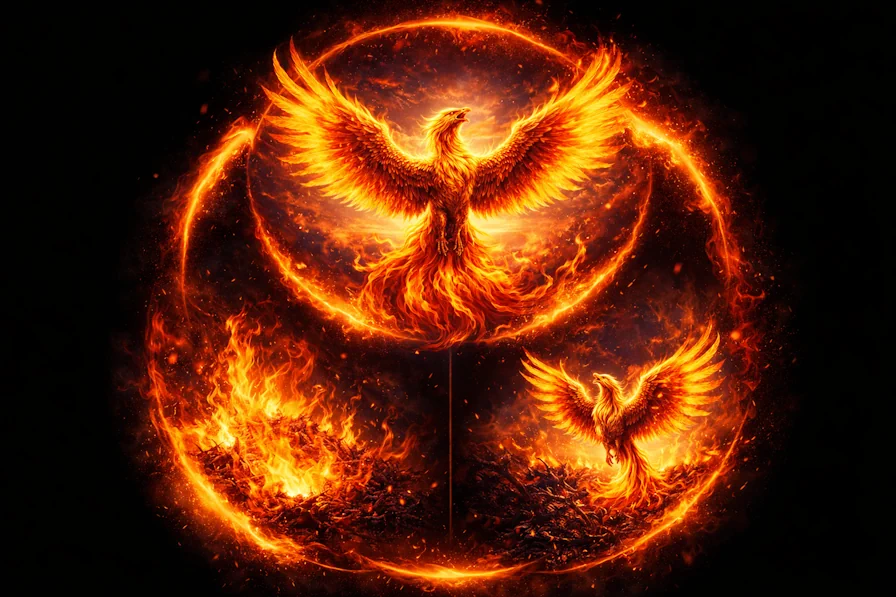
The phoenix's most defining characteristic—its cycle of death and rebirth—varies dramatically across traditions. In Greek accounts, the phoenix lives precisely 500 years (some sources say 540, 1000, or even 1461 years) before sensing death's approach. It builds a nest of aromatic wood—cinnamon, myrrh, and frankincense—then ignites this pyre through the sun's heat or by fanning flames with its own wings. The fire reduces everything to ashes except a small worm or egg from which a new phoenix emerges, gathers the remains in myrrh, and flies to Heliopolis to deposit them at the temple of Ra. Three days later, the reborn phoenix begins its new cycle.
Different cultures interpret this cycle's meaning diversely. Christian symbolism emphasized resurrection and eternal life—the phoenix dying and rising after three days paralleled Christ's death and resurrection, making it a powerful religious emblem. Alchemists saw the phoenix as representing the philosopher's stone: matter transformed through fire into something transcendent, base material becoming spiritual gold. Eastern traditions often depicted the cycle as less violent: the Fenghuang doesn't necessarily die in flames but transforms gracefully, representing evolution rather than destruction. Modern interpretations explore psychological dimensions: the phoenix's cycle as metaphor for overcoming trauma, addiction, or personal crisis—burning away what you were to become who you need to be.
The universality of phoenix-like creatures suggests something fundamental in human psychology: our need to believe that endings enable beginnings, that what seems lost can be recovered, that renewal remains possible. Egyptian Bennu birds symbolized the flooding Nile's cycle—death in drought, rebirth in flood—carrying practical agricultural wisdom alongside spiritual meaning. Chinese Fenghuang represented harmony and balance, appearing only when worthy rulers governed justly, serving as both blessing and judgment. Their presence confirmed heaven's approval; their absence indicated cosmic displeasure. This made the Fenghuang not just a mythical creature but a political symbol.
In Persian and Islamic traditions, the Simurgh combined phoenix characteristics with griffin-like features: enormous size, wisdom beyond measure, and the power to purify all waters and lands it touched. The Simurgh nested in the Tree of Knowledge at the center of the world, and every seed that grew on earth came from this tree. When the Simurgh took flight, these seeds scattered, spreading diversity across creation. The Slavic Firebird (Zhar- Ptitsa) added elements of danger and temptation—its feathers glowed with stunning beauty, but pursuing them led heroes into peril. Capturing a Firebird often required cunning rather than strength, making it as much trickster as divine creature. Hindu mythology's Garuda, while not phoenixes in the rebirth sense, shares their solar associations, serving as Vishnu's mount and possessing similar magnificence and power.
Game designers love phoenixes for both mechanical and aesthetic reasons. Mechanically, self-resurrection creates interesting gameplay: Do you defeat the phoenix multiple times? Does it become stronger with each rebirth? Final Fantasy made phoenixes legendary as summons that could revive fallen party members—expensive but powerful abilities that captured the phoenix's thematic essence. World of Warcraft's phoenix mounts, particularly Ashes of Al'ar, became status symbols partly because their visual design was so striking: trails of fire, glowing feathers, the fantasy of riding an immortal bird through the sky. Dungeons & Dragons phoenixes appear across multiple editions as both allies and challenges, often with resurrection mechanics that force players to think strategically about timing and tactics.
In tabletop RPGs, phoenixes work wonderfully as quest objectives, allies, or transformation catalysts. Perhaps characters seek phoenix tears to cure a plague, phoenix feathers to craft legendary weapons, or phoenix eggs as rare treasures. A phoenix might serve as patron to a warlock, granting fire magic with resurrection abilities but demanding the warlock regularly confront mortality. Campaign arcs could center on a corrupted phoenix whose rebirths spread blight instead of renewal, or an ancient phoenix seeking someone worthy to carry its knowledge before final death. The phoenix's vulnerability during rebirth creates natural protection quests: defend the ashes until the phoenix reforms. For game masters seeking more legendary creature options, consider phoenixes alongside dragons and unicorns in your world-building.
These are the phoenixes that transcended mere stories to become cultural touchstones—beings whose names appear in ancient texts, religious iconography, and the foundational myths of civilizations. The Bennu witnessed creation itself in Egyptian theology. The Fenghuang graced Chinese imperial courts as living proof of righteous governance. The Simurgh possessed wisdom spanning the destruction and recreation of the world three times over. These aren't just names; they're keys to understanding how different cultures conceptualized immortality, transformation, and the sacred. Whether you're researching mythology, creating culturally grounded fantasy characters, or seeking authentic names that carry historical weight, these legendary phoenixes offer rich inspiration rooted in actual belief systems and traditional storytelling.
Celestial phoenixes embody the connection between fire birds and the heavens—creatures born from starlight, dwelling in solar temples, or marking their rebirths by astronomical events. These names evoke the majesty of sunrise and sunset, the brilliance of stars and constellations, the eternal nature of celestial bodies. Solaris aligns with the sun's cycles, Aethon burns with the first dawn's light, while Polaris guides travelers through darkness like the North Star guides ships. Perfect for phoenixes serving as divine messengers, celestial guardians, or creatures whose very existence bridges earth and sky. Use these names for characters that radiate hope, illuminate darkness, or serve as harbingers of new beginnings. They work beautifully in high fantasy settings where phoenixes function as semi- divine beings, or in space fantasy where cosmic phoenixes navigate stellar expanses.
While all phoenixes connect to fire, elemental phoenixes expand beyond pure flame to embrace other primal forces: ice, storm, earth, and water. Cryonis Frostflame burns with paradoxical cold fire, Tempest Stormwing emerges from hurricanes, while Magmos the Lavaborn dwells in volcanic chambers. These names suit stories exploring phoenix diversity or game settings where elemental variation adds mechanical depth. An ice phoenix's "flames" might freeze enemies while still maintaining rebirth themes through seasonal cycles. Earth phoenixes could renew landscapes, their ashes fertilizing entire valleys. Storm phoenixes ride lightning and thunder, while water phoenixes emerge from boiling geysers as living steam. This category offers tremendous creative freedom: What would a shadow phoenix be like? A phoenix of living crystal? These variations maintain phoenix mythology's core—death and renewal—while exploring new aesthetic and thematic territories.
Ancient phoenixes have witnessed eons pass—their memories span the rise and fall of empires, the shifting of continents, the birth and death of languages. Primus the First Flame claims to have existed since fire itself was created. Chronos Timewing remembers when mountains were young. These aren't just old phoenixes; they're living history, repositories of lost knowledge, witnesses to events that preceded written records. Use these names for phoenixes serving as wise counselors, ancient guardians of forbidden lore, or creatures whose perspective spans so many lifetimes that mortal concerns seem fleeting and insignificant. They work wonderfully as mentor figures who've literally "seen it all before" or as ultimate challenges—defeating a being that's survived ten thousand years requires more than brute force. Their names carry weight and gravitas, suggesting creatures who command respect through sheer age and accumulated wisdom rather than raw power alone.
Mystical phoenixes blur boundaries between physical and magical, mortal and divine, past and future. Oracle Visionwing sees possible futures in its flames. Enigma the Veiled changes form with each rebirth. Nexus Portalwing creates gates between worlds. These phoenixes possess abilities beyond standard fire and flight: prophecy, shapeshifting, dimension-walking, time manipulation. Their names suit high-magic fantasy settings where phoenixes aren't just powerful creatures but living nexuses of magical energy. Mystique Shadowflame's black flames illuminate rather than consume—a paradox that captures the mysterious nature of these beings. Use these names for phoenixes serving as plot devices in complex narratives: a time-displaced phoenix that appears at crucial moments, a dream-walking phoenix that manifests in visions, or a prophetic phoenix whose rebirths coincide with world-changing events. They work beautifully for stories exploring the metaphysical or psychological dimensions of transformation and renewal.
Guardian phoenixes dedicate their immortal existence to protecting something or someone—temples, bloodlines, treasures, sacred flames, or even abstract concepts like justice or hope. Sentinel Flameward has maintained a temple's eternal flame for over a thousand years. Protector Ashguard watches over generations of the same family. These phoenixes embody duty, loyalty, and sacrifice—qualities that make them compelling allies or obstacles depending on what they guard. Their immortality makes them uniquely suited to long-term protection: A phoenix guardian doesn't die of old age, doesn't abandon its post, and literally returns from death to continue its duties. Use these names for phoenixes bound by oaths, serving as temple guardians, protecting artifacts of power, or watching over endangered species. They work wonderfully as quest-givers (prove yourself worthy to gain their aid) or as bosses (defeat the guardian to claim what it protects). Their dedication makes them honorable opponents even when serving as antagonists.
Royal phoenixes rule other fire birds, command vast territories, and bear the weight of leadership across centuries. Empress Goldenplume reigns over an entire mountain range, her court numbering hundreds. King Flamecrown's authority is symbolized by a crown of living fire that never dims. These names suit phoenixes in leadership roles: monarchs of phoenix nations, noble houses with hereditary territories, or royal advisors to mortal kingdoms. The combination of immortality and royalty creates interesting dynamics—imagine a phoenix king who's ruled for ten generations of human subjects, whose political wisdom comes from watching countless dynasties rise and fall. Use these names for phoenixes involved in politics, diplomacy, or stories about succession and heritage. Prince Emberheart learning to rule, Duchess Luminara navigating court intrigue, or Imperial Phoenix Radiant whose rebirth celebrations span entire kingdoms—these names ground phoenixes in social structures while maintaining their mythological grandeur.
Ready to create legendary phoenix names for your stories, games, or creative projects? Try our phoenix name generator for instant inspiration combining celestial, elemental, and mythological elements. Whether you need names for immortal fire birds in fantasy novels, RPG campaigns, or game development, our generator creates authentic-sounding phoenix names that capture their legendary status and eternal nature. Explore more mythological creature naming guides in our articles collection, including names for dragons, unicorns, angels, and other legendary beings.
The phoenix is an immortal fire bird from world mythology that cyclically dies in flames and is reborn from its own ashes. It appears in Egyptian (Bennu), Greek, Chinese (Fenghuang), Persian (Simurgh), and Slavic (Firebird) traditions, symbolizing renewal, resurrection, and eternal life.
Phoenix names typically combine elemental references (fire, light, sun) with descriptors (eternal, radiant, blazing). Effective patterns include: Element + Feature (Flameheart, Emberwing), Celestial + Aspect (Dawnbringer, Starfire), or cultural references (Bennu, Fenghuang, Simurgh). The name should evoke immortality and power.
Famous phoenix names include: Bennu (Egyptian sun bird), Fenghuang (Chinese imperial phoenix), Simurgh (Persian wise bird), Zhar-Ptitsa (Slavic Firebird), Suzaku (Japanese vermillion bird), Garuda (Hindu divine eagle), and Anka (Arabian phoenix). Each represents different cultural interpretations of the phoenix archetype.
In most mythological traditions, the phoenix experiences infinite rebirths, making it truly immortal. The cycle typically occurs every 500-1000 years (varying by tradition), with the phoenix building a nest, igniting it, and emerging renewed from the ashes. Some versions suggest the rebirth process continues eternally.