
Loading...
Loading...
A list-first guide to 300+ angel names with meanings, including guardian angel names, celestial angelic names, biblical and traditional angels, fallen angels, and unique fantasy ideas.
The most familiar angel names are Michael, Gabriel, Raphael, and Uriel, while broader lists of names of angels often include Azrael, Chamuel, Jophiel, Zadkiel, Raziel, Metatron, and Sandalphon. Angelic names usually sound luminous and ancient because many use Hebrew-style endings like -el or -iel, pointing back to God, light, healing, judgment, or divine service. If you need original celestial character names, start with the archangel names below, then try the angel name generator for fresh variations.
Use the matching Angel Names without leaving the article. Pick a style, generate fresh names, and copy the good ones.
Style
Choose a style before generating.
6 names ready to copy.
Starter names from the generator
Use this article when you want curated angel names with meanings, then open the angel name generator when you need fresh celestial, guardian, fallen, or fantasy variations for a specific character.
Generator hubs
Use these hubs for angels, fallen characters, divine messengers, fantasy parties, and the stories around them.
If you only need a fast shortlist, start here: Ariel, Azrael, Barachiel, Cassiel, Dumah, Gabriel, Haniel, Jophiel, Lailah, Michael, Nathaniel, Orifiel, Perpetiel, Raguel, Sachiel, Uriel, Verchiel, and Zadkiel all work as guardian or celestial names.
Use Michael, Gabriel, Raphael, Uriel, Jibril, Israfil, or Metatron when the story intentionally draws on a specific religious or mystical tradition.
Use Aureliel, Celestiel, Luminarael, Seraphion, or Vesperiel when you want an angelic sound without presenting a sacred figure as canon.
Lucifer, Samael, Azazel, Belial, and Mastema suit tragic or antagonistic angels. For darker opposition, compare our demon names and villain names lists.
Angel names can be sacred to living communities. Treat them as tradition-bearing names rather than exotic fantasy labels, and invent new forms when your story changes theology heavily.
Traditional angel names work best when the setting is explicitly biblical, apocryphal, Islamic, Jewish mystical, or liturgical. Invented angel names work better for original fantasy worlds, games, and stories where celestial beings have their own pantheon. The safest pattern is to borrow the music of angelic names—light vowels, -el and -iel endings, virtue imagery—while avoiding claims that a new character belongs to a real tradition.
Angels stand at the intersection of divine will and mortal existence, serving as bridges between the sacred and the mundane. These luminous beings have captivated human imagination for millennia, appearing in religious texts, mystical visions, and cultural traditions spanning every civilization. Unlike their darker counterparts the demons, angels can mean hope, protection, judgment, terror, or divine intervention, depending on the tradition. Seraphim burn with celestial fire. Guardian angels stay close to human lives. Fallen angels carry a different kind of story entirely. Our ultimate guide to fantasy creature names covers many of these beings in depth. Their names, often ending in sacred suffixes like "-el" (of God) or "-iah" (Yahweh), often point to a role, attribute, or relationship with the divine in Jewish, Christian, Islamic, and esoteric traditions.
The concept of angels emerged from the confluence of ancient Near Eastern religions, where divine messengers served as intermediaries between gods and mortals. Mesopotamian civilizations depicted winged protective spirits called Karibu—guardians who inspired the biblical Cherubim. Persian Zoroastrianism contributed the Amesha Spentas, six immortal beings who emanated from the supreme deity Ahura Mazda, establishing patterns that would influence Abrahamic angelology for centuries. The Hebrew Bible introduced mal'akh (messengers) who appeared to prophets and patriarchs, often manifesting as ordinary humans before revealing their divine nature. These encounters transformed into systematic angelology during the Second Temple period, when Jewish mystics developed elaborate hierarchies and named countless angels for specific tasks. Early Christianity absorbed and expanded these traditions, with writers like Pseudo-Dionysius codifying the nine choirs of angels that dominated medieval theology. Islamic tradition added its own angelology, describing beings created from pure light who execute divine commands with complete obedience. Over time, these traditions gave writers and artists a large shared vocabulary of messengers, guardians, watchers, and fallen beings.
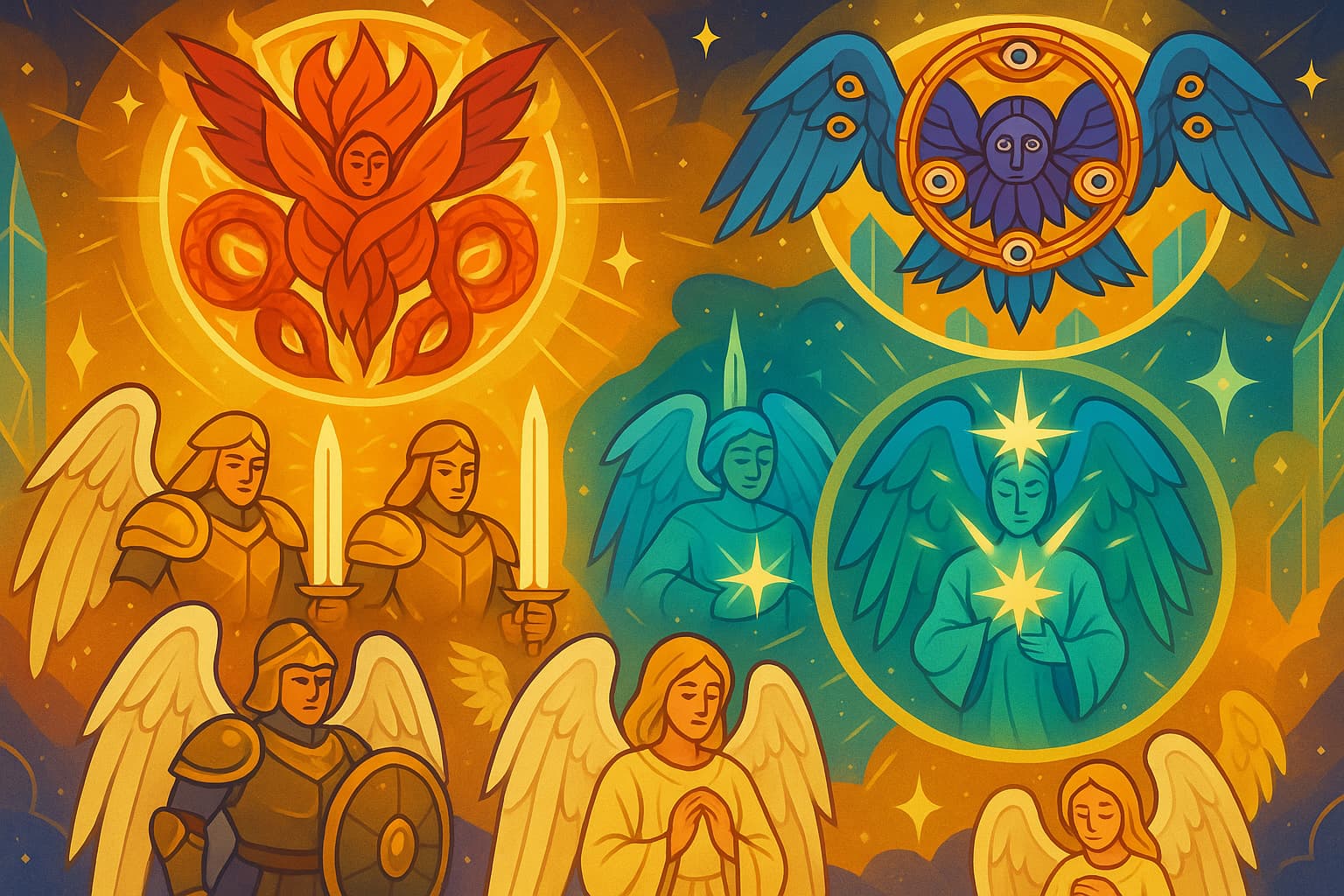
Angels manifest in forms far stranger and more magnificent than popular culture suggests. Biblical descriptions reveal beings that inspire awe and terror in equal measure:
Medieval theologians, building on biblical and apocryphal texts, organized angels into three spheres of three choirs each, creating a cosmic organizational chart that reflects divine order:
Angelic names follow specific patterns that reveal their nature and function. Understanding these patterns helps decode the meaning embedded in each celestial designation.
Angels exist within broader mythological ecosystems. Explore names of other supernatural beings like dragons, wizards, and unicorns for broader fantasy world-building, or explore the opposing forces with our collection of demon names.
While Western culture primarily draws from Judeo-Christian angelology, angelic beings appear in remarkably similar forms across global spiritual traditions. Islamic tradition recognizes angels (malaikah) created from pure light, including Jibril (Gabriel) who revealed the Quran, Mikail (Michael) who provides sustenance, Azrael who separates souls from bodies, and Israfil who will blow the trumpet on Judgment Day. Zoroastrian religion features the Amesha Spentas, six divine emanations who guard aspects of creation—Vohu Manah (Good Purpose), Asha Vahishta (Truth), and others who predate Abrahamic angels by centuries. Jewish mysticism developed elaborate systems mapping angels to the Kabbalistic Tree of Life, with each Sephirah guarded by specific angelic princes. Hindu tradition includes the Devas, celestial beings who serve cosmic order, while Buddhism recognizes various classes of divine messengers and protectors. These convergences suggest either universal human archetypes or ancient cultural exchanges that spread angelic concepts across continents. Modern syncretism has created New Age interpretations blending Eastern and Western traditions, emphasizing personal guardian angels and angelic healing practices that democratize access to celestial assistance.
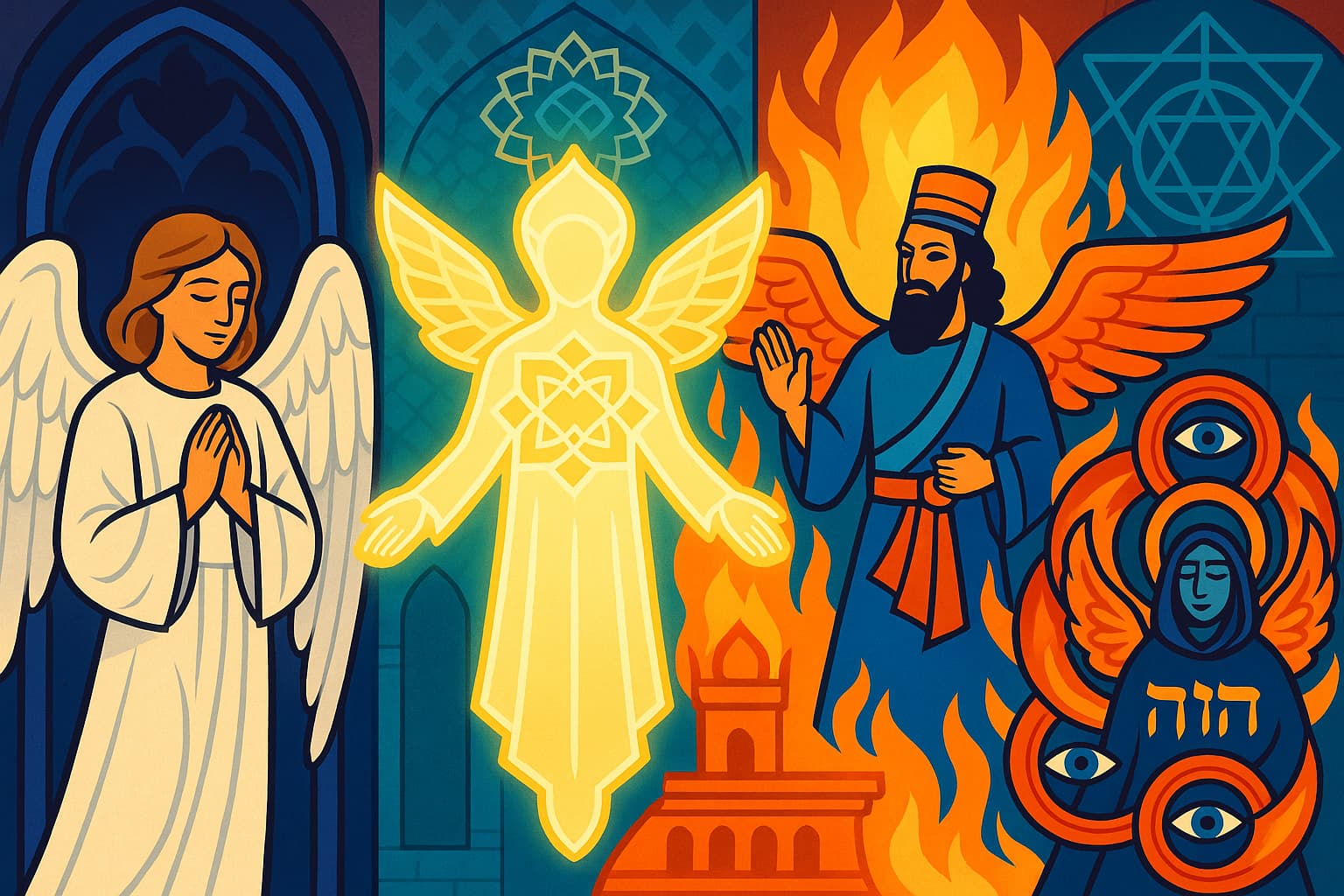
Many religious stories hinge on angelic encounters. Gabriel appears to Mary in the Annunciation. Jacob wrestles through the night at Peniel and receives the name Israel. Abraham receives three visitors before Isaac's birth, and angels rescue Lot from Sodom. In Islamic tradition, Jibril guides Muhammad on the Night Journey. Joan of Arc claimed guidance from saints and angels, including Michael. These stories are not interchangeable, but they show why angel names carry so much weight in fantasy and religious writing.
Crafting believable angel characters requires moving beyond stereotypes to explore their complex nature. These guidelines help develop celestial beings with depth and authenticity.
Angels like Michael command armies, so their names should feel direct and difficult to ignore. Give them military bearing, certainty in their cause, and the cost of fighting beings they once knew. Names ending in -el that suggest strength work well here: Camael, Suriel, Zaphkiel.
Angels like Gabriel serve as divine intermediaries, translating cosmic will into human language. They possess clear communication skills but often struggle to convey infinite concepts in finite words. Give them frustration with mortal limits, compassion for human confusion, and the loneliness of carrying knowledge they cannot fully share. Names with communication themes work well: Raphael, Anael, Phanuel.
Personal protectors develop intimate knowledge of their charges, witnessing every moment of mortal lives. They feel joy at triumphs and heartbreak at failures but cannot interfere with free will. That tension gives guardian angels their bite: they may know what will hurt, but still have to watch a person choose. Guardian names often reflect protection: Barachiel, Layla, Moroni, Perpetiel.
Once-celestial beings who chose rebellion over obedience offer complex redemption arcs. They retain angelic powers and knowledge but corrupt them toward selfish ends, wrestling with pride, regret, and yearning for what they lost. Are they irredeemable villains or tragic heroes? The ambiguity creates narrative depth. Fallen angel names carry irony—Lucifer (light-bearer) fell furthest, while names like Azazel, Samael, or Belial evoke both celestial origins and dark purposes.
Modern entertainment has reimagined angels for secular audiences, creating interpretations that range from faithful to fantastical. Urban fantasy series like "Supernatural" and "Good Omens" present angels as bureaucratic cosmic agents with human flaws and divine powers, while films like "City of Angels" explore the poignancy of immortal beings longing for mortal experiences. Video games from "Diablo" to "Bayonetta" transform angels into combat-ready warriors with complex moral alignments, neither purely good nor simply antagonistic. Comics like "Lucifer" (and its TV adaptation) interrogate free will and rebellion through an angel's decision to abandon heaven for Los Angeles. Young adult fiction has embraced fallen angel romances, trading theological complexity for emotional drama as celestial beings navigate high school hierarchies. These adaptations demonstrate angels' remarkable flexibility as archetypes—they can represent authority or rebellion, purity or temptation, comfort or terror depending on narrative needs. Like other luminous beings such as phoenixes and fairies, the core elements persist: supernatural power, connection to higher purpose, and the tension between divine nature and individual desire. Whether protecting humanity, judging souls, or questioning their own existence, contemporary angels reflect modern anxieties about faith, free will, and the nature of good and evil in an increasingly complex world.
Explore our comprehensive collection of angel names organized by tradition, function, and hierarchy. Each name includes its meaning, origin, and significance in angelic lore.
These are the angel names most readers will recognize: archangels, messengers, protectors, and figures from scripture, prayer, and art. Use them when you want a character to carry immediate religious or mythic weight, and be careful not to treat living traditions as decorative lore.
Seraphim and cherubim are strange even by angel standards: burning wings, many faces, wheels, eyes, and a scale that does not fit neat human categories. Use these names for ancient guardians, cosmic messengers, or angels whose presence should feel unsettling rather than sweet.
Guardian angel names usually point to protection, patience, healing, wisdom, or comfort. They work best for characters who stay close to one person, watching more than acting, and carrying the frustration of knowing when they cannot interfere.
These names come from scripture, apocrypha, and older angel traditions. Some belong to watchers, some to angels tied to natural forces, and some to figures whose roles shift from one source to another. They give writers room to work, but they still come with religious context.
Angels governing celestial bodies, natural elements, and seasonal cycles. Drawing from medieval astrology and hermetic tradition, these beings bridge cosmic forces and earthly phenomena. Each planet has its ruling angel—Michael for the Sun, Gabriel for the Moon, Raphael for Mercury—who channels that celestial body's influence into the material world. Elemental angels command fire, water, air, and earth, shaping weather and natural events. Seasonal angels mark the turning of the year. Use these for stories involving cosmic magic, natural disasters as divine intervention, or angels whose power manifests through specific elements or planetary alignments.
These names come from Jewish mysticism, especially traditions around the Kabbalistic Tree of Life and merkabah (chariot) mysticism. Some record divine words, guide souls, or guard specific Sephiroth. Names such as Metatron and Sandalphon come with a lot of context, so they work best when the story has room for hidden knowledge, spiritual ascent, or mystical hierarchy.
Angel-like beings appear in Islamic, Jewish, Zoroastrian, and other traditions, but they are not all the same thing with different labels. Use these names when the story has a reason to engage with that tradition, and check the source before turning a sacred figure into a generic fantasy NPC.
These invented names borrow angelic patterns like -el, -iel, and -ael without claiming to be traditional names. They are useful for original fantasy worlds, science fiction with spiritual elements, or stories where a real archangel would bring the wrong baggage.
Start with the angel's role, then decide whether you want a traditional name, an invented fantasy name, or something between the two.
Choose names appropriate to the angel's rank and role: Archangels need powerful, commanding names; Guardian angels suit protective, gentle names; Seraphim and Cherubim require names reflecting their proximity to the divine.
Reference biblical, Kabbalistic, or other religious and mystical traditions. Each tradition offers unique naming conventions and meanings.
Incorporate elements meaning "of God," light, fire, or other celestial phenomena. Traditional angel names often contain divine suffixes like "-el" or "-iel".
Choose names that hint at the angel's specific mission or domain, whether messenger, healer, warrior, or guide.
Generate angel names that mix sacred-sounding endings, light imagery, and character roles for fantasy angels, guardians, and messengers.angel name generator
Need more angel name options for a character, guardian, or celestial order? Our angel name generator creates authentic heavenly names drawing from biblical, mystical, and cultural traditions. Whether you need a powerful archangel for an epic fantasy, a compassionate guardian for a coming-of-age story, or a mysterious celestial being for urban fantasy, our generator provides names with the divine resonance that makes angels unforgettable. Explore related generators for complete world-building: discover demonic adversaries, create mystical sorcerers, or name legendary dragons that might serve or oppose your celestial beings, or build a star-bright setting with the spaceship name generator.
An illustrated reference to angels and celestial beings for naming inspiration.
Disclosure: we may earn a commission if you buy through these links, at no extra cost to you.
Good angel names include Michael, Gabriel, Raphael, Uriel, Ariel, Azrael, Cassiel, Jophiel, Zadkiel, Seraphiel, and Barachiel. For fantasy characters, invented names such as Aureliel, Celestiel, Luminarael, and Seraphion keep the same luminous sound without borrowing a sacred figure directly.
Angel names with meanings often use Hebrew theophoric elements. Michael means "Who is like God?", Gabriel means "God is my strength", Raphael means "God heals", Uriel means "God is my light", and Azrael is commonly interpreted as "helper of God" or an angel associated with souls and death.
Guardian angel names A to Z can range from Ariel, Barachiel, Cassiel, Dumah, Gabriel, Haniel, Jophiel, Lailah, Michael, Nathaniel, Orifiel, Perpetiel, Raguel, Sachiel, Uriel, Verchiel, and Zadkiel to invented fantasy forms such as Aurielis or Vesperiel.
Traditional angel names come from scripture, apocrypha, liturgy, mysticism, or established folklore. Invented fantasy angel names borrow the sound patterns of those names, especially endings like -el, -iel, and -ael, but are made for original worlds where you want a celestial feel without claiming religious authority.
Many angel names are religious or culturally important, especially in Jewish, Christian, Islamic, and mystical traditions. Use them with care when writing about living faiths, and consider invented angelic names for games, villains, romances, or stories that take major creative liberties.
Unique angelic names include Celestiel, Luminarael, Aurelion, Seraphion, Vesperiel, Dawniel, Solarael, Miraleth, and Aurielis. These work well for original fantasy angels, celestial guardians, fallen angels, or divine messengers in worlds that are not tied to one religious canon.